
If you charge an e-bike, cordless drill, scooter, or power bank at home, check the charger, the battery, and the space around it before plugging it in. Keep charging away from things that can burn and from the doors you would need to escape. A swollen or flood-damaged pack should never go back on the charger just to see whether it still works.
Fire Prevention Week runs October 4–10, 2026, and this year’s NFPA campaign focuses on safe charging. Pinellas County also updated its battery-disposal information on September 14. For Tampa Bay households, it’s a useful time to check the equipment sitting in the garage and the old batteries waiting in a drawer.
Check your charging spot before you plug in
Follow the instructions for your particular device and battery. Pinellas Suncoast Fire & Rescue recommends products listed by a recognized testing laboratory, such as UL, ETL, or CSA, and using the cord and charger supplied with the device. If you need a replacement, ask the manufacturer which battery and charger are approved for that model. A plug that fits isn’t enough to establish compatibility.
- Use a hard, flat charging surface. Keep batteries off beds, couches, and pillows, and away from paper, cardboard, and other materials that can burn.
- Keep e-bikes and scooters out of hallways, stairwells, and doorways when charging. Don’t block an exit.
- Stay nearby and awake while charging an e-bike or scooter. Don’t leave it charging overnight or while you’re away, and unplug it when fully charged.
- Keep spare packs away from combustible materials, direct sunlight, and hot cars.
A Florida garage isn’t automatically a suitable charging space. The U.S. Fire Administration says not to charge lithium-ion batteries below 32°F or above 105°F and recommends room-temperature storage when possible. Follow any narrower temperature range in your product’s instructions. If the charging area is too hot, wait until you have a location and temperature that meet those instructions.
If you live in a condo or rental, check the building’s charging and storage rules too. A convenient outlet in a common hallway doesn’t make that an appropriate place to charge.
Stop using a battery that changes shape, leaks, or gets unusually hot

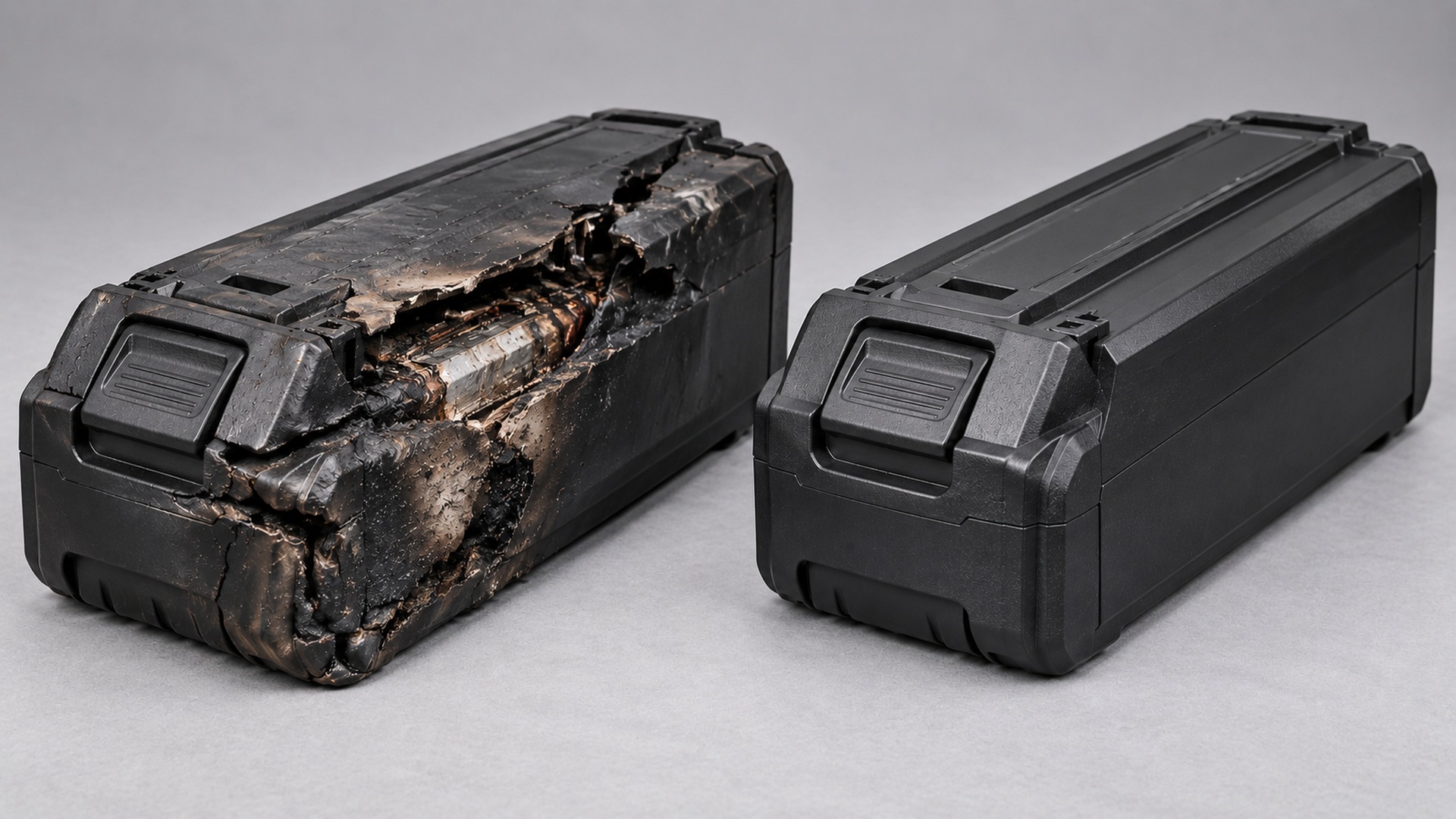
The U.S. Fire Administration lists unusual heat, a change in shape or color, leaking, an odor, and odd sounds as reasons to stop using a lithium-ion battery. Don’t wait for damage as dramatic as the featured illustration. A smaller change can still need attention, and a clean-looking case doesn’t prove that a battery is safe.
Don’t charge, puncture, open, or try to repair a damaged pack. For a damaged battery that isn’t showing an active emergency, contact the manufacturer and your local hazardous-waste program for handling instructions before transporting it. Tell them about the damage; an ordinary retail collection bin may not accept it.
If a battery is smoking, hissing, popping, giving off a chemical odor, or showing signs of fire, get everyone away, get outside, and call 911 from a safe location. Stay out. Don’t delay leaving to unplug it or carry it through the house. Pinellas Suncoast Fire & Rescue’s advice is to get away and call 911 when these warning signs appear.
Don’t test a battery that has been through a flood
A device drying out doesn’t establish that its battery is safe. Pinellas Suncoast Fire & Rescue warns that saltwater residue inside a pack can cause a short circuit and a fire days or even weeks after flooding.
Don’t charge, start, or test a flooded e-bike, scooter, power tool, or other lithium-ion device. Don’t bring flooded equipment indoors. Contact the manufacturer and local fire department for instructions appropriate to the device and its condition. If it shows emergency warning signs, get away and call 911 rather than trying to move it.
Before a storm, move small battery-powered tools and spare packs out of areas that could flood when you can do so safely. Plan ahead rather than handling damaged equipment after the water rises. For address-based storm planning, see Tampa Bay evacuation zones versus flood zones.
Use the right battery drop-off program
Lithium-ion batteries don’t belong in your household trash or curbside recycling. They can start fires when crushed in collection trucks or processing equipment. The route depends on the battery’s size, condition, and chemistry, not just whether it came from a household item.
Hillsborough County
Hillsborough County’s battery-disposal page lists its Community Collection Centers, household hazardous-waste events, and participating retail take-back options. Its accepted household items include power-tool batteries and small rechargeable or single-use lithium batteries, subject to the county’s size limits. Bring a state-issued photo ID with a Hillsborough County residential address to county collection sites.
The county lists rechargeable and other small batteries as 12 inches or smaller and excludes large batteries over 12 by 12 inches, along with business batteries. Check with the county before bringing a long e-bike pack or another battery near or beyond those limits. Don’t assume every site that accepts a drill battery will accept a larger pack.
For ordinary batteries accepted by the program, the county instructs residents to cover terminals with clear packing tape, keep the battery type visible, and place each battery in an individual zip-close plastic bag, except lead-acid batteries. Those are routine collection instructions, not a reason to handle a hot, swollen, leaking, or otherwise damaged battery. Call first for instructions on damaged packs.
Devices with built-in rechargeable batteries, such as laptops and tablets, can go to Community Collection Centers, but electronics are not accepted at the county’s household hazardous-waste events. Don’t dismantle a device to remove its built-in battery.
Pinellas County
Pinellas County’s battery-disposal instructions direct residents to designated drop-off locations for rechargeable batteries and several types of non-rechargeable batteries. Its Where Does It Go? search tool lets you choose Homes or Businesses and look up the specific item.
If the battery won’t come out of the device, call the receiving location and ask whether it accepts the whole item. Confirm that it accepts your battery’s size and condition before making the trip, especially for an e-bike pack or damaged battery.
Both counties distinguish ordinary alkaline batteries from lithium and rechargeable batteries. Batteries labeled alkaline can go in household trash under their published instructions, but not in curbside recycling. If you can’t identify the chemistry, ask the collection program instead of guessing.
Common battery-safety questions
Can I charge an e-bike or power-tool battery in a hot Florida garage?
Only if the location and temperature meet the manufacturer’s instructions and the charging setup keeps exits clear and combustible materials away. The U.S. Fire Administration says not to charge lithium-ion batteries above 105°F or below 32°F. Your product may have a narrower range. Don’t assume a garage is cool enough simply because it’s shaded.
What should I do if a rechargeable battery swells or gets unusually hot?
Stop using and charging it. Don’t open or repair the pack. Ask the manufacturer and local hazardous-waste program how to handle a damaged battery before transporting it. If it is smoking, hissing, popping, giving off a chemical odor, or showing signs of fire, get away, leave the building, and call 911 from a safe place.
Is a battery safe to use after floodwater exposure?
Don’t assume so, even when the outside is dry. Don’t charge or test flooded lithium-ion equipment. Saltwater residue can cause delayed fires. Contact the manufacturer and local fire department for instructions, and treat any emergency warning signs as a reason to get away and call 911.
Where can I take old batteries, and what if I can’t remove one from its device?
Use Hillsborough County’s collection and take-back information or Pinellas County’s Where Does It Go? tool. Confirm the receiving site’s size and condition limits. Hillsborough accepts electronics with built-in batteries at Community Collection Centers, not household hazardous-waste events. In Pinellas, call the drop-off location about accepting the whole device. Don’t dismantle it to force the battery out.
Before a move or garage cleanout
If you’re clearing a home before selling, sort batteries before the junk haul or curbside pickup. Set aside ordinary used batteries for the proper collection route, and get handling instructions for damaged or flood-exposed equipment. That keeps a rushed cleanout from turning a battery problem into a trash-truck problem.
Sources and image note
- NFPA: Fire Prevention Week 2026 and safe charging
- U.S. Fire Administration: Battery fire safety
- Pinellas Suncoast Fire & Rescue: Battery safety and flood exposure
- Hillsborough County: Accepted batteries, preparation, and collection locations
- Pinellas County: Battery disposal and drop-off options
The featured image is an AI-generated conceptual comparison of damaged and intact battery packs. It does not show a documented incident or a tested product. An intact appearance is not a safety certification.


