
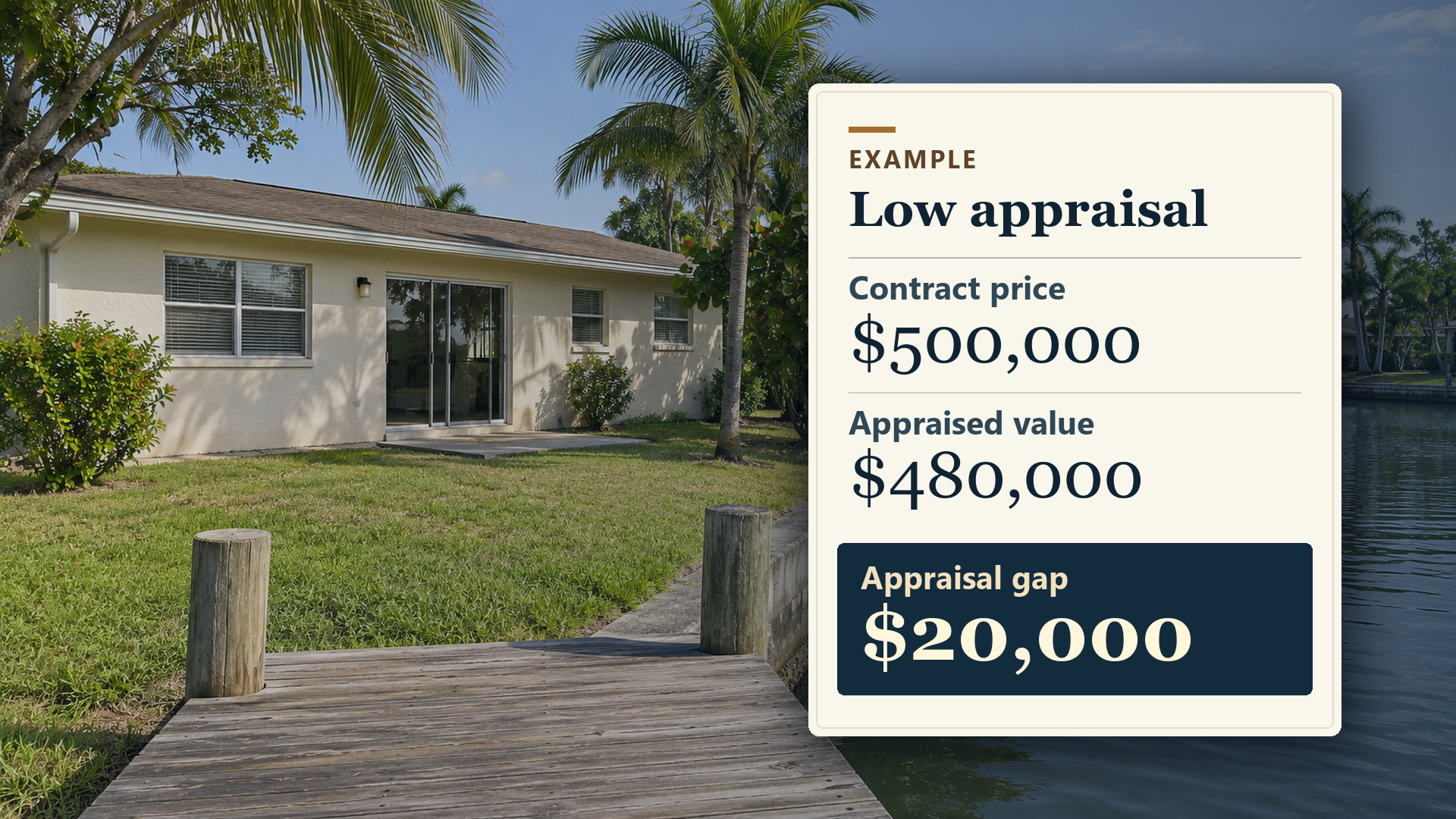
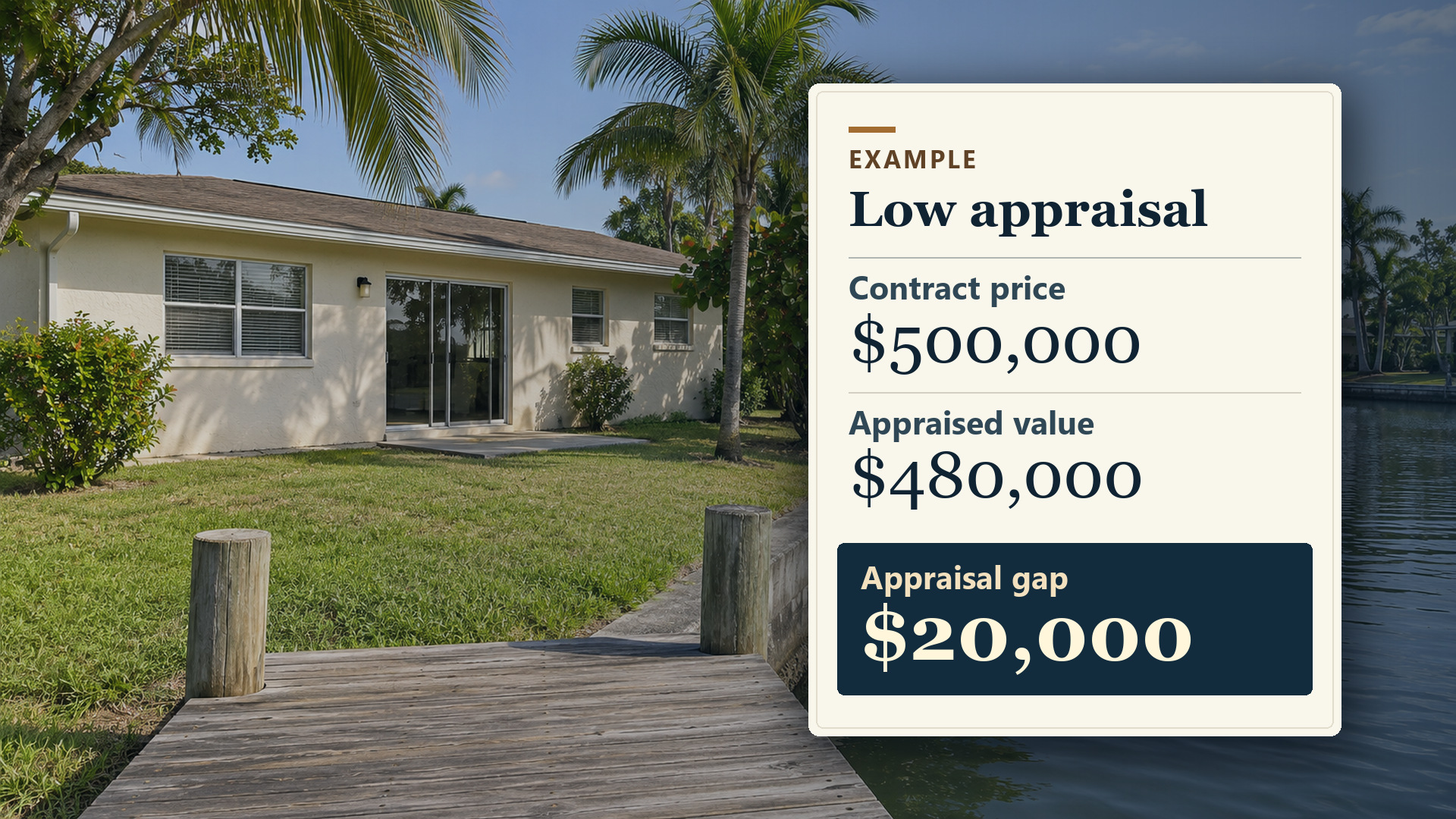
You accepted $500,000 for your house. The appraisal comes back at $480,000, and the buyer asks you to drop the price by $20,000. I wouldn’t say yes or put the house back on the market yet. First, find out what the buyer can still borrow and what your contract allows. Then put a price on waiting for another buyer.
Read the signed contract before you counter
On the Florida Realtors/Florida Bar forms, the financing contingency and a separate appraisal rider do different things. If the financing contingency applies, the issue is whether the lender will accept the appraisal for the financing spelled out in the contract. A low number doesn’t always stop the loan. If you signed an appraisal rider, it may give the buyer a way out when the appraisal is below the amount written in the rider. An FHA or VA rider can have its own protection.[1]
Check which terms you signed, what notices have already been sent and when the next written notice is due. Don’t assume that talking about a new price or asking for an appraisal review buys you more time. If a cancellation or deposit is in dispute, have a Florida real estate attorney review the signed documents before you act.[5]
Ask the buyer’s agent to confirm with the lender how much the buyer can still borrow and how much cash the buyer can bring. That tells you whether there’s a deal left to negotiate.
Check whether the appraisal missed a better sale
Say you’re selling a canal-front ranch in Pinellas County, and the report leans heavily on homes a few streets inland. An inland sale can still be relevant if the report accounts for the difference. I’d first check whether a recent closed sale on a similar canal was left out, and whether the report got the home’s waterfront access, living area and condition right. Pinellas County’s comparable sales tool lets you filter for waterfront sales and see sale dates and prices.[4]
If you find a specific error or a stronger sale, send the address, closing date, price and reason it’s relevant to the buyer’s agent. The buyer can ask their lender about a reconsideration of value, which is a formal review. The lender may leave the original value in place. A low number on its own isn’t evidence of an error.[3] For more on what makes two reports disagree, see why appraisals differ.
Compare what you’d keep at each price
Back to the $500,000 contract and $480,000 appraisal. For this example, assume a conventional loan capped at 80% of the lower of the price or appraised value. The buyer expected to borrow $400,000. With the new appraisal, the loan would be $384,000 at any of the three prices below. Your buyer’s loan terms may be different, so use the amount their lender confirms.[2]
| Option | Sale price | Buyer cash toward the price* | Estimated seller proceeds** |
|---|---|---|---|
| Reduce to the appraised value | $480,000 | $96,000 | $151,200 |
| Split the price gap | $490,000 | $106,000 | $160,600 |
| Keep the contract price | $500,000 | $116,000 | $170,000 |
* Excludes the buyer’s closing costs and prepaid expenses.
** Illustrative only: assumes a $300,000 mortgage payoff, selling costs equal to 6% of the price, and no buyer credits. The 6% is for the example, not a quote or a standard fee.
At $490,000, you’d keep $9,400 more than if you cut all the way to the appraised value. The buyer would need $106,000 toward the price, $6,000 more than the $100,000 they originally planned. Keeping the full price only works if the lender confirms the financing and the buyer is willing and able to bring the extra cash.
Work out what a new offer would have to pay
Say the buyer can close at $490,000 now. If finding and closing with someone else takes two extra months and costs you $3,600 in mortgage interest, property taxes, insurance and upkeep, a new buyer would have to close at about $493,830 just to match the $160,600 you could keep today. That assumes the same percentage selling costs and no meaningful change in payoff or credits. Use mortgage interest for the cost of waiting if you’re already accounting for the loan payoff separately; principal reduces what you owe.
A new sale at $500,000 would leave about $166,400 after the extra holding costs in this example. That’s $5,800 more than the deal you have now. I wouldn’t count on that extra money without recent sales that support the price. The next financed buyer could run into the same appraisal problem. If the current deal falls through, confirm the contract is properly resolved before putting the home back on the market.
If this just happened to you, send me the property address. I can pull nearby sales and help you compare what you’d keep under the offer you have and what a new offer would need to bring in.
Common questions about a low appraisal
Do I have to lower my price if the buyer’s appraisal comes in low?
Generally, the appraisal itself doesn’t change the sale price you agreed to. You can consider a price change, but check the signed terms before deciding what happens if you and the buyer don’t agree.[1]
Can the buyer cancel and get their deposit back after a low appraisal?
Sometimes. The signed contingencies and riders, the lender’s decision and the required notices all matter. A low appraisal alone doesn’t settle what happens to the deposit.[1][5]
Can I ask for an appraisal review if the report missed a sale?
You can provide the evidence to the buyer’s side. The buyer can ask their lender to review it. Show why the sale is a better comparison rather than just pointing out that it sold for more.[3]
How do I tell whether relisting could leave me with more?
Start with what you’d keep from the offer you can close now. Then estimate what you could keep from a new sale after closing costs, buyer credits, the mortgage payoff and the extra cost of owning the home until it closes. If the second number only wins under an optimistic price or timeline, you may be better off taking the deal you have.


